

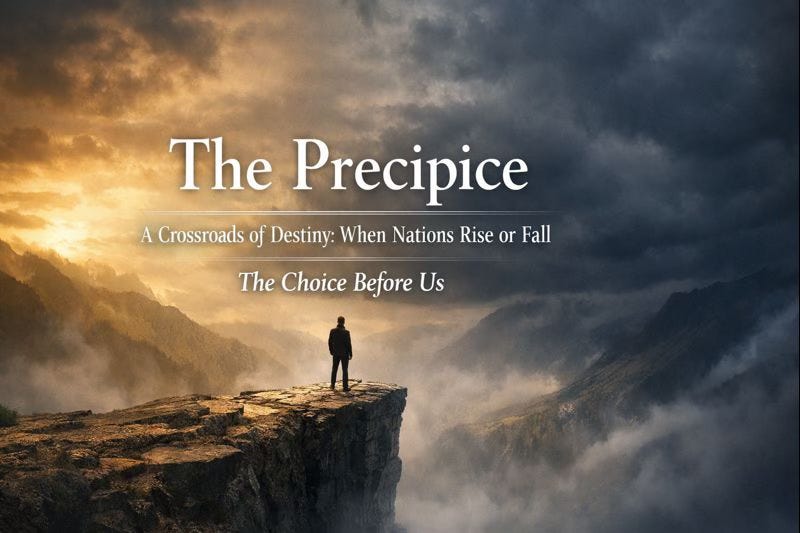
The Precipice
A Crossroads of Destiny: When Nations Rise or Fall

Standing at the Edge
We stand at the edge. Not the edge of a cliff, though that image serves well enough, but at something far more consequential—the edge of a decision that will define the trajectory of our civilization for generations to come. Throughout the long chronicle of human history, nations and peoples have arrived at moments when the ground beneath them narrows to a razor’s edge, a precipice where the next step determines everything.
The word itself carries a double meaning that we dare not ignore: a precipice can plunge into an abyss of destruction and despair, or it can mark the summit before a glorious horizon of renewal and blessing. The difference lies entirely in which direction we choose to face, and more importantly, toward Whom we turn our gaze.
Scripture is replete with such moments, and secular history confirms their pattern with remarkable consistency. When peoples and nations humble themselves before the Almighty, acknowledging their dependence upon Him and turning from wickedness, the precipice becomes a launching point for unprecedented blessing. When they harden their hearts and pursue the idols of power, pleasure, and self-sufficiency, the precipice becomes their grave.
We find ourselves at such a moment now. The signs are unmistakable for anyone with eyes to see. The question before us is not whether we stand at a precipice—that much is clear. The question is which way we will turn.
Part I: When Nations Forgot Their God
The pattern of apostasy—of turning away from the living God—is one of the most consistent themes in all of Scripture and human history. It is a pattern we ignore at our peril, for it reveals truths about human nature and divine response that remain as relevant today as they were three thousand years ago.
Ancient Israel: The Tragedy of Forgotten Love
Consider ancient Israel in the decades before the Babylonian exile. The temple still stood in Jerusalem, its golden fixtures gleaming in the sun. The priests still performed their sacrifices. The festivals were observed with appropriate ceremony. To an outside observer, the nation appeared to be fulfilling its religious obligations.
But God, who looks upon the heart, saw something far different. Through the prophet Jeremiah, He declared: “My people have committed two evils: they have forsaken me, the fountain of living waters, and hewed out cisterns for themselves, broken cisterns that can hold no water“ (Jeremiah 2:13). The nation had maintained the outward forms of religion while abandoning its substance. They had forgotten their first love.
The people had grown prosperous during the long reign of relative peace, and prosperity had bred complacency. They began to adopt the practices of surrounding nations—not only their commerce and culture, but their gods. Altars to Baal and Asherah dotted the high places. Children were sacrificed to Molech in the Valley of Hinnom. The rich oppressed the poor, and justice was sold to the highest bidder.
Jeremiah wept as he warned them, but they mocked the weeping prophet. They told themselves that the temple of the Lord would protect them, that God would never allow His dwelling place to be destroyed. They confused the symbol with the reality, the building with the Presence.
And so the temple fell. The walls crumbled. The people were led away in chains to Babylon—not because God had abandoned them, but because they had abandoned Him. The precipice had tilted toward destruction because the nation refused to turn back to their God.
Jerusalem: When Religion Rejected Its Redeemer
Centuries later, another precipice emerged in that same holy city. The long-awaited Messiah walked among His people, healing the sick, raising the dead, casting out demons, and proclaiming the Kingdom of God. The prophecies of Isaiah and Daniel and Micah were being fulfilled before their very eyes. The blind received sight, the lame walked, lepers were cleansed, and the poor had good news preached to them.
Yet the religious leaders of the day—men who had devoted their entire lives to studying the scriptures that testified of Him—refused to recognize their Deliverer. He didn’t fit their paradigm. They expected a conquering king who would overthrow Rome and restore Israel’s political glory. Instead, He came as a servant, washing feet and touching lepers.
He challenged their authority and exposed their hypocrisy. He ate with tax collectors and forgave sinners without consulting the religious establishment. He declared that the prostitutes and tax collectors would enter the Kingdom before the scribes and Pharisees. And so they chose darkness over light.
Jesus Himself wept over the city as He foresaw its fate: “If you had known, even you, especially in this your day, the things that make for your peace! But now they are hidden from your eyes. For days will come upon you when your enemies will build an embankment around you, surround you and close you in on every side, and level you, and your children within you, to the ground; and they will not leave in you one stone upon another, because you did not know the time of your visitation“ (Luke 19:42-44).
Within forty years, the Roman legions under Titus surrounded the city. The temple was destroyed—not one stone left upon another, exactly as Jesus had prophesied. Over a million Jews perished, and the survivors were scattered among the nations. The precipice had become an abyss because the religious leaders chose their paradigm over their Messiah.
Rome: When an Empire Chose Bread and Circuses
The Roman Empire, which at its height ruled nearly a quarter of the world’s population, did not fall in a single dramatic collapse. It rotted from within over centuries, a slow decay that began long before the barbarian invasions that would deliver the final blow.
The Romans had once been a people of sturdy virtue—industrious, disciplined, devoted to family and civic duty. But prosperity bred decadence. The simple faith of their ancestors gave way to a proliferation of cults and imported gods, each promising satisfaction without sacrifice. The Roman masses demanded bread and circuses—entertainment and ease—while the hard work of citizenship was increasingly outsourced to slaves and mercenaries.
Sexual morality collapsed. The birth rate plummeted as Romans prioritized pleasure over procreation. Abortion and infanticide became commonplace. The family unit—the foundation of Roman society—disintegrated. Divorce became so common that the satirist Seneca observed that some Roman women counted their years not by the consuls, but by their husbands.
The parallels to our own time are striking and should give us pause. When a civilization prioritizes entertainment over responsibility, pleasure over virtue, and self-gratification over sacrifice, it has already begun its descent from the precipice. Rome did not need the Visigoths to destroy it; Rome had already destroyed itself from within. The barbarians merely collected the corpse.
Revolutionary France: When Men Became Their Own Gods
In the years leading up to the French Revolution, the intellectual elite of France had thoroughly rejected Christianity in favor of Enlightenment rationalism. Voltaire famously declared that he would crush the “infamous thing”—his term for the Church. The philosophes taught that man, guided by reason alone, could build a perfect society without need of God or revelation.
The corruption of the French clergy and aristocracy had indeed provided ample fodder for criticism. But the revolutionaries did not seek reform; they sought to remake humanity according to their own design. They replaced the Christian calendar with a new one beginning at Year One of the Republic. They converted Notre Dame Cathedral into a “Temple of Reason” and enthroned an actress as the goddess of Reason upon the high altar.
The result was not utopia but the Reign of Terror. The guillotine became the instrument of “virtue,” and tens of thousands lost their heads for insufficient revolutionary fervor. The revolution devoured its own children: Danton guillotined Hébert, Robespierre guillotined Danton, and Robespierre himself met the same fate. When men declared themselves gods, they created only hell on earth.
The French experiment in godless revolution would echo through the following centuries—in the Soviet gulags, in the killing fields of Cambodia, in the Cultural Revolution of Mao. Every attempt to build paradise without God has produced only new variations of hell. This is the lesson of history that our generation desperately needs to learn.
Part II: When Nations Remembered Their God
But the precipice does not always end in tragedy. History also records remarkable moments when nations teetering on the edge of destruction turned their faces toward heaven—and found deliverance beyond anything they could have imagined. These moments remind us that no situation is too desperate for God, and no people are beyond the reach of His mercy if they will only humble themselves and seek His face.
Nineveh: When a Wicked City Repented
Nineveh was the capital of the Assyrian Empire—the most brutal and feared power of the ancient world. The Assyrians were legendary for their cruelty: they skinned captives alive, impaled enemies on stakes, and built pyramids of severed heads. When God sent Jonah to proclaim judgment against Nineveh, the prophet’s reluctance is understandable. These were not people who seemed capable of repentance.
Yet when Jonah finally delivered his message—”Yet forty days, and Nineveh shall be overthrown!“—something extraordinary happened. The king of Nineveh rose from his throne, removed his royal robes, covered himself with sackcloth, and sat in ashes. He issued a decree commanding every person and even every animal to fast and pray, declaring: “Who can tell if God will turn and relent, and turn away from His fierce anger, so that we may not perish?“ (Jonah 3:9).
And God did relent. The city that deserved destruction received mercy because it humbled itself. An entire nation—a nation of notorious sinners—turned from its evil ways in genuine repentance. The precipice became a turning point, and Nineveh was spared.
If God could extend mercy to Nineveh, He can extend mercy to any nation that turns to Him. This is the hope we must hold onto in our present hour.
Josiah’s Reformation: When the Word Was Rediscovered
By the time young Josiah ascended to the throne of Judah at the age of eight, the nation had reached spiritual rock bottom. His grandfather Manasseh had been the most wicked king in Judah’s history, filling Jerusalem with altars to foreign gods, practicing sorcery and divination, and even sacrificing his own son to Molech. The temple of the Lord had been desecrated and abandoned. The Book of the Law had been lost—not stolen, but simply forgotten, buried under years of neglect.
But Josiah, despite growing up surrounded by paganism, sought the Lord. In the eighteenth year of his reign, while overseeing repairs to the neglected temple, the high priest Hilkiah discovered the Book of the Law. When it was read to the king, Josiah tore his robes in anguish as he realized how far his nation had strayed from God’s commands.
What followed was one of the most comprehensive spiritual reformations in biblical history. Josiah personally led the destruction of the pagan altars and high places. He removed the idolatrous priests and desecrated the altar at Bethel that Jeroboam had built. He reinstituted the Passover, which had not been properly observed since the days of the judges—a period of over three hundred years.
Scripture records this remarkable assessment: “Before him there was no king like him, who turned to the Lord with all his heart, with all his soul, and with all his might, according to all the Law of Moses; nor after him did any arise like him“ (2 Kings 23:25). One man, committed to God’s Word and willing to lead by example, turned an entire nation back from the brink.
The Welsh Revival: When Heaven Touched Earth
Wales in 1904 was a land of coal mines and chapels, but the chapels had grown cold. Church attendance was declining, and the young people seemed increasingly indifferent to matters of faith. The mining communities, despite their Methodist heritage, were marked by drunkenness, gambling, and violence.
Then came Evan Roberts, a twenty-six-year-old former coal miner who had experienced a profound encounter with the Holy Spirit. Roberts began to preach a simple message focused on four points: confess all known sin, remove anything doubtful from your life, obey the Holy Spirit promptly, and publicly confess Christ.
What followed was nothing short of supernatural. Within months, over 100,000 people had professed conversion. Churches that had struggled to fill a few pews were now packed to overflowing, with services lasting from early evening until the early morning hours. There was no formal preaching in many gatherings—just spontaneous prayer, testimony, and singing that seemed to flow directly from the Spirit of God.
The effects extended far beyond the church walls. The crime rate dropped so dramatically that some police departments had nothing to do and formed quartets to sing at revival meetings. Magistrates were presented with white gloves, signifying no cases to try. Coal miners, notorious for their profanity, cleaned up their language so thoroughly that the pit ponies, trained to respond to curse words, no longer understood their commands and had to be retrained.
Taverns closed for lack of customers. Gambling dens shut down. Old debts were paid. Stolen goods were returned. Feuding families reconciled. A nation that had been sliding toward spiritual oblivion experienced a dramatic reversal—all because a critical mass of ordinary people turned their hearts toward God.
Dunkirk: When a Nation Fell to Its Knees
In the darkest hours of the twentieth century, when the shadow of Nazi tyranny spread across Europe and the very survival of freedom hung in the balance, something remarkable happened. By late May 1940, the situation appeared hopeless. The German blitzkrieg had shattered the Allied lines, and over 300,000 British and French soldiers were trapped on the beaches of Dunkirk, awaiting what seemed like certain death or capture.
King George VI called for a National Day of Prayer. On May 26, 1940, churches across Britain overflowed with worshippers as the nation humbled itself before God. The Archbishop of Canterbury led prayers, and millions joined in crying out for divine intervention.
What followed has been called the “Miracle of Dunkirk.” The English Channel, notorious for its violent storms, became as calm as a millpond—allowing hundreds of small civilian vessels to cross and assist in the evacuation. An unusual fog settled over Dunkirk, hiding the troops from German aircraft. Hitler inexplicably ordered his tanks to halt their advance for three crucial days.
Against all military logic, over 338,000 soldiers were rescued. Churchill had hoped to save perhaps 30,000. The nation that had fallen to its knees in prayer witnessed a deliverance that defied natural explanation.
Throughout the war, Allied leaders repeatedly called their nations to prayer—and the greatest organized evil the modern world had ever seen was ultimately defeated. The precipice swung upward because the people turned their faces toward heaven.
The Jesus Movement: When Counterculture Met Christ
By the late 1960s, American culture seemed to be coming apart at the seams. The Vietnam War divided the nation. Race riots burned through inner cities. The sexual revolution undermined traditional morality. Drug use exploded among the youth. The counterculture movement openly rejected the values and institutions that had built Western civilization.
Yet within this chaos, an unexpected spiritual awakening emerged. Beginning in California and spreading across the nation, thousands of young people—hippies, drug users, radicals—encountered Jesus Christ and were transformed. They brought their countercultural style into their new faith: gathering on beaches for baptisms, meeting in coffeehouses instead of cathedrals, playing rock music with Christian lyrics.
The movement had its flaws and excesses, as all human movements do. But its impact was undeniable. Churches that had been dying suddenly filled with young converts. Contemporary Christian music was born. A generation that seemed lost to the faith found their way home. Time magazine featured Jesus on its cover, asking if God was dead—only to witness a spiritual resurrection among the very youth who had been most alienated from the church.
The Jesus Movement reminds us that God can reach any generation, no matter how far they have strayed. What looks like cultural collapse can become the fertile ground for spiritual breakthrough—if the Church is willing to meet seekers where they are while remaining anchored in timeless truth.
Part III: The Present Precipice
Today, we stand at another such moment. The signs surround us, impossible to ignore for anyone with eyes to see. We have arrived at a precipice as consequential as any in our nation’s history—and perhaps in the history of Western civilization itself.
A Culture in Collapse
Our culture is not merely drifting—it is accelerating away from the foundations that once anchored Western civilization. The trajectory is unmistakable for anyone willing to see it honestly.
In our schools, children are being instructed in ideologies that would have been unthinkable a generation ago. They are taught that the very biological reality of male and female is subject to personal preference, that truth itself is merely a construct to be deconstructed. Curricula that once transmitted the wisdom of civilization now deconstruct that wisdom as nothing more than oppression dressed in respectable clothes. Parents who object are labeled as threats; their concerns are dismissed as bigotry.
Churches that hold to biblical teaching on sexuality and marriage are branded as purveyors of hate. Professionals who dare to question the new orthodoxy face career destruction. The tolerance our society once celebrated has become a one-way street, offering protection only to those who embrace the progressive vision of human flourishing.
Our entertainment industry saturates the culture with content that glorifies violence, degrades sexuality, and mocks virtue. The average child is exposed to thousands of hours of media that systematically undermines everything their grandparents held sacred. We have traded transcendence for technology, worship for entertainment, and the fear of the Lord for the fear of social disapproval.
The Statistical Reality
The statistics tell a sobering story that no optimistic spin can disguise. Church attendance in America has plummeted to historic lows. For the first time in our nation’s history, fewer than half of Americans belong to a house of worship. Weekly church attendance, which stood at over 40% for decades, has now fallen below 30% and continues to decline.
Among younger generations, the numbers are even more alarming. Over 40% of millennials identify as religiously unaffiliated—the so-called “nones.” For Generation Z, the percentage is higher still. A generation is growing up not merely ignorant of Christianity but actively hostile to it, having absorbed the cultural narrative that faith is at best a private superstition and at worst a force for oppression.
But this is not merely an American phenomenon. In the United Kingdom, recent surveys reveal that less than half the population now identifies as Christian—a nation that once sent missionaries to the ends of the earth, that gave us Wesley and Whitefield and Spurgeon, now struggles to fill its ancient cathedrals with anything more than tourists. France, once called the eldest daughter of the Church, is now majority secular. Germany, birthplace of the Reformation, has seen church membership plummet to the point where historic churches are being sold and converted into nightclubs and apartments.
We have called evil good and good evil, put darkness for light and light for darkness. The prophet Isaiah spoke of such times, and we are living in them.
Part IV: The Choice Before Us
And yet—and this is the hope we must not abandon—we are still on the precipice, not past it. The abyss has not yet swallowed us. The door of mercy remains open, though we do not know for how long.
The ancient promise of 2 Chronicles 7:14 still echoes across the centuries with undiminished power: “If my people, who are called by my name, will humble themselves and pray and seek my face and turn from their wicked ways, then I will hear from heaven, and I will forgive their sin and will heal their land.”
Notice the conditions. They are not complicated, but they are demanding.
Humility—an acknowledgment that we have not merely made mistakes but have sinned against a holy God. Not the vague admission that “society has problems,” but the specific confession that we, individually and collectively, have rebelled against our Creator. This is not popular language in a therapeutic culture that prefers to speak of dysfunction rather than sin, but it is the language of Scripture, and it is the starting point for genuine change.
Prayer—not casual requests added to the end of a busy day, but desperate seeking of God’s face. The kind of prayer that refuses to let go until the blessing comes. The kind of prayer that Evan Roberts prayed for eleven years before revival came to Wales. The kind of prayer that filled churches across Britain as the troops waited on the beaches of Dunkirk.
Repentance—an actual turning from wickedness, not merely feeling bad about it while continuing in the same direction. Repentance in the biblical sense is not primarily emotional; it is volitional. It is a change of direction, a turning of the will. It is the prodigal son rising from the pig pen and beginning the journey home.
If we do these things, the promise is clear: God will hear. God will forgive. God will heal. The precipice that threatens destruction can become the launching point for revival, reformation, and restoration beyond anything we could ask or imagine.
But there is a corresponding warning implicit in this verse. The conditional “if” works in both directions. If we refuse to humble ourselves, if we persist in our pride, if we continue down the slippery slope that has brought us to this precipice—we cannot expect healing. We can only expect the darkness to fall swiftly.
The Urgency of the Hour
History shows us what happens when nations forget their God. It also shows us what happens when they remember. The same precipice that threatens destruction can become the summit from which we glimpse a glorious horizon—if we will only turn.
The hour is late, but it is not yet midnight. The window remains open, but we do not know for how long. The God who parted the Red Sea, who shut the mouths of lions for Daniel, who raised His Son from the grave on the third day—this God still hears the prayers of His people. He is not distant or indifferent. He waits for us to turn to Him.
This is the wake-up call. This is the moment of decision. We cannot remain neutral, cannot stand indefinitely on the razor’s edge. Every day that passes, we are moving in one direction or the other—either turning toward God in all ways, or forsaking Him in every way within our society.
We must choose. You must choose. I must choose.
Will we be like ancient Israel before the exile, maintaining religious forms while our hearts grow cold? Or will we be like Nineveh, humbling ourselves before it is too late?
Will we be like the religious leaders who rejected their Messiah because He didn’t fit their expectations? Or will we be like the Welsh miners who fell on their knees and saw heaven touch earth?
Will we continue on the path of Rome—trading virtue for entertainment, sacrifice for pleasure, until we have nothing left to defend when the barbarians arrive? Or will we cry out like the people of Britain on the beaches of Dunkirk, and discover that God still delivers those who call upon His name?
The Precipice Awaits Our Answer
The precipice is before us. We cannot go back. We cannot stay where we are. We can only go forward—either upward toward the horizon God has prepared for those who love Him, or downward into the darkness that always follows when nations forsake their Creator.
The choice is not made in legislative halls or electoral booths alone, though those matter. The choice is made in millions of individual hearts—in your heart, and in mine. It is made in whether we will humble ourselves or remain proud, whether we will pray or remain distracted, whether we will repent or remain comfortable in our compromise.
I have seen both directions. In my encounter with eternity, I glimpsed both the glory that awaits those who follow Christ and the terrible reality that awaits those who reject Him. I have devoted the years since then to calling people to the decision that will determine their eternal destiny.
Now that same decision stands before our nation—before the nations of the Western world—before the world itself. We are at the precipice. The ground is narrowing beneath our feet. The next step will determine everything.
May we have the wisdom to see the hour in which we live. May we have the humility to acknowledge our desperate need. May we have the courage to fall on our knees before it is too late. And may God, in His infinite mercy, grant us revival—one more great awakening before the final trumpet sounds.
The precipice awaits our answer.
───────────────────
“Now choose life, so that you and your children may live and that you may love the Lord your God, listen to his voice, and hold fast to him.”
— Deuteronomy 30:19-20
Thank you for this lesson in human history and God’s disappointments throughout the ages including today. I would like to be a part of an organized prayer group praying for the Nations asking for the Holy Spirit to lead us in repentance and revival. I am a Canadian and you have made me aware that there is a universality in this and that we are in a critical period of time with our Holy Lord God Almighty. ✝️🔥💝🙏🙏🙏